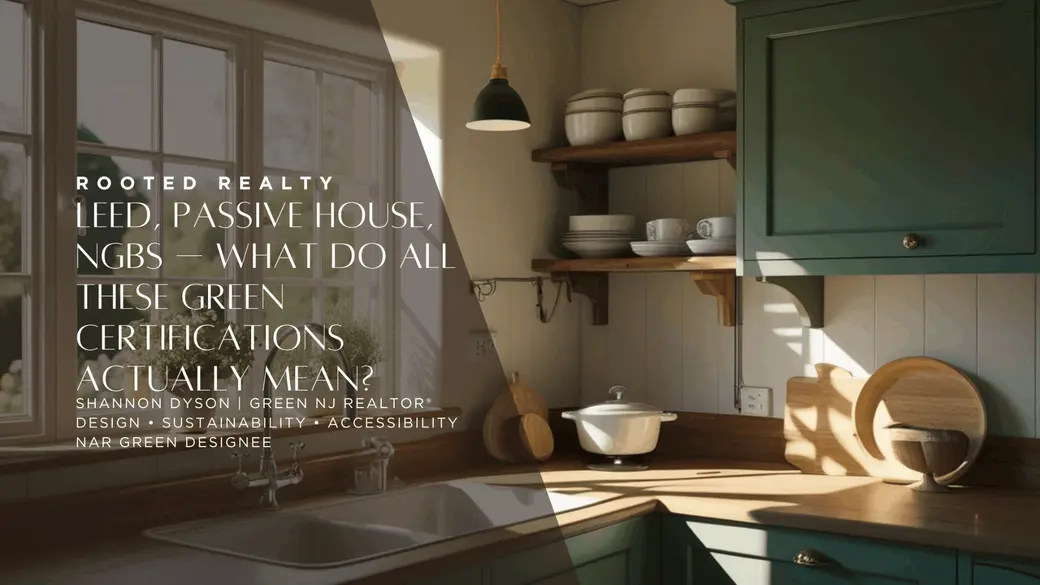
LEED, Passive House, NGBS — What Do All These Green Certifications Actually Mean?
If you've started looking into green or high-performance homes, you've probably run into a wall of acronyms pretty quickly. LEED. Passive House. NGBS. ENERGY STAR. EarthCraft. It can feel like you need a decoder ring just to read a listing description.
You're not alone in that. I've watched even seasoned buyers go quiet when these terms come up — not because they aren't smart, but because no one has taken the time to explain what each one means and why it matters.
So let's do that.
LEED for Homes — The Most Recognized Name in Green Building
LEED stands for Leadership in Energy and Environmental Design. It's a certification system developed by the U.S. Green Building Council (USGBC), and it's the most globally recognized green building standard. For residential properties, LEED for Homes evaluates a home across several categories: energy efficiency, water efficiency, indoor environmental quality, materials and resources, and the home's relationship to its surrounding community and site.
Homes are scored and awarded a level — Certified, Silver, Gold, or Platinum — with each tier representing higher performance. A LEED Platinum home is a very high-performing, carefully constructed space. But even Certified-level homes represent a meaningful step above standard construction.
Research has consistently shown that LEED-certified properties command higher sales prices and attract buyers willing to pay a premium for verified performance. The Green Building Registry maintains a national database of certified homes that can be searched by location.
Source: USGBC LEED for Homes — usgbc.org/leed/rating-systems/residential | Green Building Registry — us.greenbuildingregistry.com
Passive House — The Highest Bar for Energy Performance
Passive House (Passivhaus) is a building standard that originated in Germany and has been gaining serious traction in the U.S. It's not just an improvement on standard construction — it's a fundamentally different approach to how a building interacts with energy. Certified Passive House buildings typically use 60-90% less energy for heating and cooling than conventional homes.
The five principles it's built on: extreme insulation, thermal bridge-free construction, high-performance windows and doors, an airtight building envelope, and mechanical ventilation with heat recovery. The result is a home that is exceptionally comfortable — no drafts, no cold spots, no humidity swings — with dramatically lower energy costs.
Passive House is particularly compelling for people with health sensitivities, because the continuous fresh-air ventilation system is one of the best residential indoor air quality solutions available.
Source: Passive House Institute — passivehouse.com | Five Principles of Passive House — passivehouseaccelerator.com
NGBS — The Builder's Standard
The National Green Building Standard (NGBS) is a residential-specific certification developed through the National Association of Home Builders. It offers four performance levels — Bronze, Silver, Gold, and Emerald — and covers energy efficiency, water conservation, indoor environmental quality, site design, and resource efficiency. It's structured specifically for homebuilders and is particularly common in new construction. For buyers, an NGBS-certified home is a reliable indicator that the builder took sustainability seriously.
Source: National Green Building Standard — ngbs.com | NAHB — nahb.org
ENERGY STAR Homes — The Baseline to Know
ENERGY STAR is probably the certification most people already recognize from appliances. For homes, ENERGY STAR certification means the home has been independently verified to meet EPA energy performance guidelines — typically 20-30% more efficient than standard code-built homes. ENERGY STAR is often a component of other certifications. Many LEED and NGBS homes also carry ENERGY STAR certification. It represents a solid, credible floor of energy performance.
Source: ENERGY STAR for Homes — energystar.gov
EarthCraft — Rigorous and Regionally Focused
EarthCraft is a certification primarily found in the Southeast U.S., and it's known for particular attention to occupant health, indoor air quality, moisture management, and durability — all of which matter enormously in high-humidity climates. If you're in a region where EarthCraft is active, it's a highly credible certification to look for.
Source: EarthCraft — earthcraft.org
How to Think About These When You're Buying
Here's what I always tell people: the certification matters less than understanding what it means for your daily life in that home. What systems does it have? How is air quality managed? What's the energy cost likely to be? Has a third party verified the home's performance?
That's the real conversation. Certifications are the framework that makes it easier to have it.
Certifications tell a story — but only if someone knows how to read them. If you're looking at a green-certified home, or wondering whether a property you love actually performs the way it claims to, reach out. That kind of clarity is exactly what I'm here for.
Shannon Dyson | Green NJ Realtor® | NAR Green Designee
Design · Sustainability · Accessibility
sdyson.real@gmail.com · 732.466.6444 · Instagram: @thedancingagentnj
Categories
Recent Posts

"My job is to find and attract mastery-based agents to the office, protect the culture, and make sure everyone is happy! "