Does a Green Home Actually Hold More Value? Here's What the Research Shows
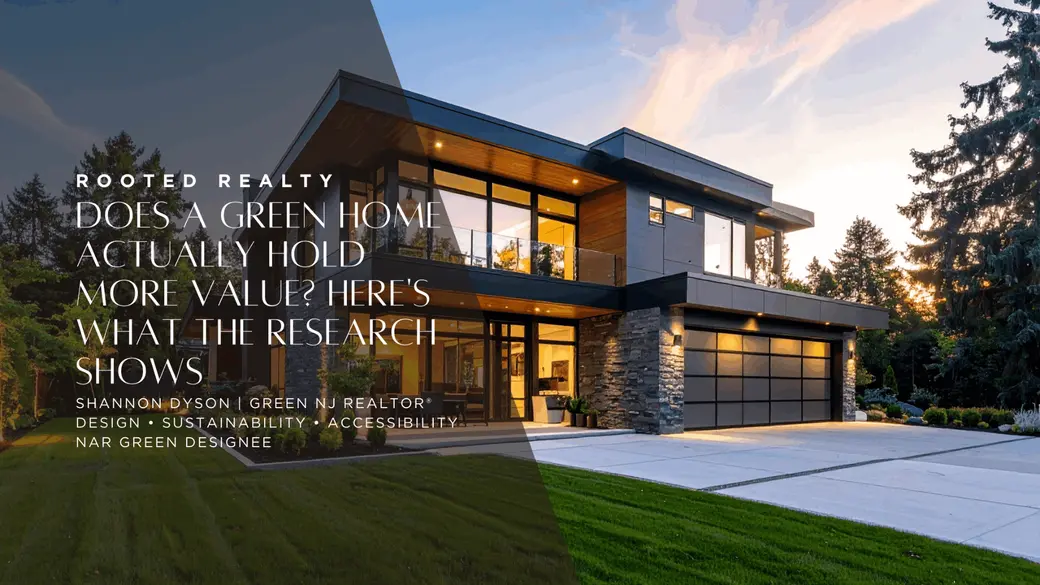
This is one of the first questions I get from sellers with green features — and from buyers considering the investment. It's a fair question, and it deserves a straight answer. Not a sales pitch, not vague reassurances. Actual data.
Here's what we know.
Solar Panels: A Well-Studied Case
Solar panels are probably the most researched green home feature when it comes to resale impact. A widely cited analysis by Zillow found that homes with solar energy systems sold for approximately 4.1% more than comparable homes without them. Lawrence Berkeley National Laboratory research has consistently shown a positive price premium for solar homes, with buyers willing to pay more for the ongoing energy cost savings.
The nuance is in how solar is structured. Owned systems add value cleanly. Leased systems can complicate a transaction — the lease obligation transfers to the new buyer, and not every buyer is willing or able to take it on. This is a detail that matters enormously in listing and negotiation, and it's worth understanding before you go to market.
Source: Do Solar Panels Increase Home Value? — ecowatch.com/solar/solar-panels-increase-home-value | PV Value Tool — pvvalue.com
The PEARL Score — Capturing What Appraisers Often Miss
PEARL Certification is a growing tool in green real estate, designed to document and communicate the value of a home's high-performance features — insulation levels, HVAC efficiency, air sealing, solar, smart home systems — in a format that appraisers and lenders can actually use.
The problem PEARL addresses is real: many green and high-performance features don't show up on a standard MLS listing, and appraisers often lack the tools or comparable data to properly value them. This means high-performance homes can be chronically undervalued in the appraisal process — which affects the seller's return and the buyer's financing. PEARL provides a certification and report that travels with the property and makes those features legible to the market.
Source: PEARL Certification — pearlscore.com
The Appraisal Gap — Why It Matters
Here's something that doesn't get talked about enough: the green premium can be real in terms of buyer willingness to pay, but if the appraiser doesn't account for it, the deal can fall apart. This is a systemic issue in real estate.
The Appraisal Institute has developed a Green Addendum — a supplemental form designed to help appraisers document and value energy-efficient and green features. But not all appraisers are trained in its use. If you're buying or selling a green home, requesting an appraiser with green valuation training is genuinely important. The Green Home Institute maintains a directory of green appraisers, and the Appraisal Institute offers green resources and professional education.
Source: Find a Green Appraiser — greenhomeinstitute.org/how-to-find-a-green-appraiser/ | Appraisal Institute — appraisalinstitute.org/education/education-resources/green-resources
The Broader ROI Picture
The Remodeling magazine Cost vs. Value report provides annual data on renovation ROI across regions, including the Mid-Atlantic. What the research consistently shows is that energy-efficient improvements — insulation, air sealing, HVAC upgrades, efficient windows — do contribute to value, but the degree depends on your market, how well features are documented, and whether the local buyer pool values them.
NAR's annual Realtors and Sustainability Report tracks buyer interest in green and energy-efficient features across the country — and year over year, that interest continues to grow. A significant and rising percentage of buyers report that energy efficiency is important in their home search. The market is moving toward recognizing this value more clearly.
Source: Cost vs. Value Mid-Atlantic — jlconline.com/cost-vs-value/2025/middle-atlantic/ | NAR Sustainability Research — nar.realtor/research-and-statistics/research-reports/realtors-and-sustainability
What This Means Practically
If you own a high-performance home, make sure your features are documented. Get a PEARL certification, work with a green-trained appraiser, and make sure your listing agent knows how to communicate these features clearly and compellingly.
If you're buying a high-performance home, understand that you may be getting value the sticker price doesn't fully reflect — but make sure the features are verified, not just claimed. The right documentation makes all the difference.
Whether you're selling a home with green features or buying one and trying to understand what it's actually worth — this is an area where having the right agent in your corner matters. I work with green-trained appraisers and know how to position these features in a transaction. Let's talk about what you're working with.
Shannon Dyson | Green NJ Realtor® | NAR Green Designee
Design · Sustainability · Accessibility
sdyson.real@gmail.com · 732.466.6444 · Instagram: @thedancingreagentnj
Categories
Recent Posts

"My job is to find and attract mastery-based agents to the office, protect the culture, and make sure everyone is happy! "